

You won’t see a Weightlifter lift in anything other than specialized Olympic Weightlifting shoes. And that’s because of the benefits that Weightlifting shoes provide over other footwear when practicing the sport of Weightlifting.
Weightlifting shoes have an elevated heel that allows you to get into deeper, more upright positions during the squat and classical lifts in Olympic Weightlifting. This places greater stress on the quadriceps and reduces stress on the lower back.
But what makes Weightlifting shoes so different to your typical running shoe?
Table of Contents
Benefits Of Weightlifting Shoes vs Running Shoes
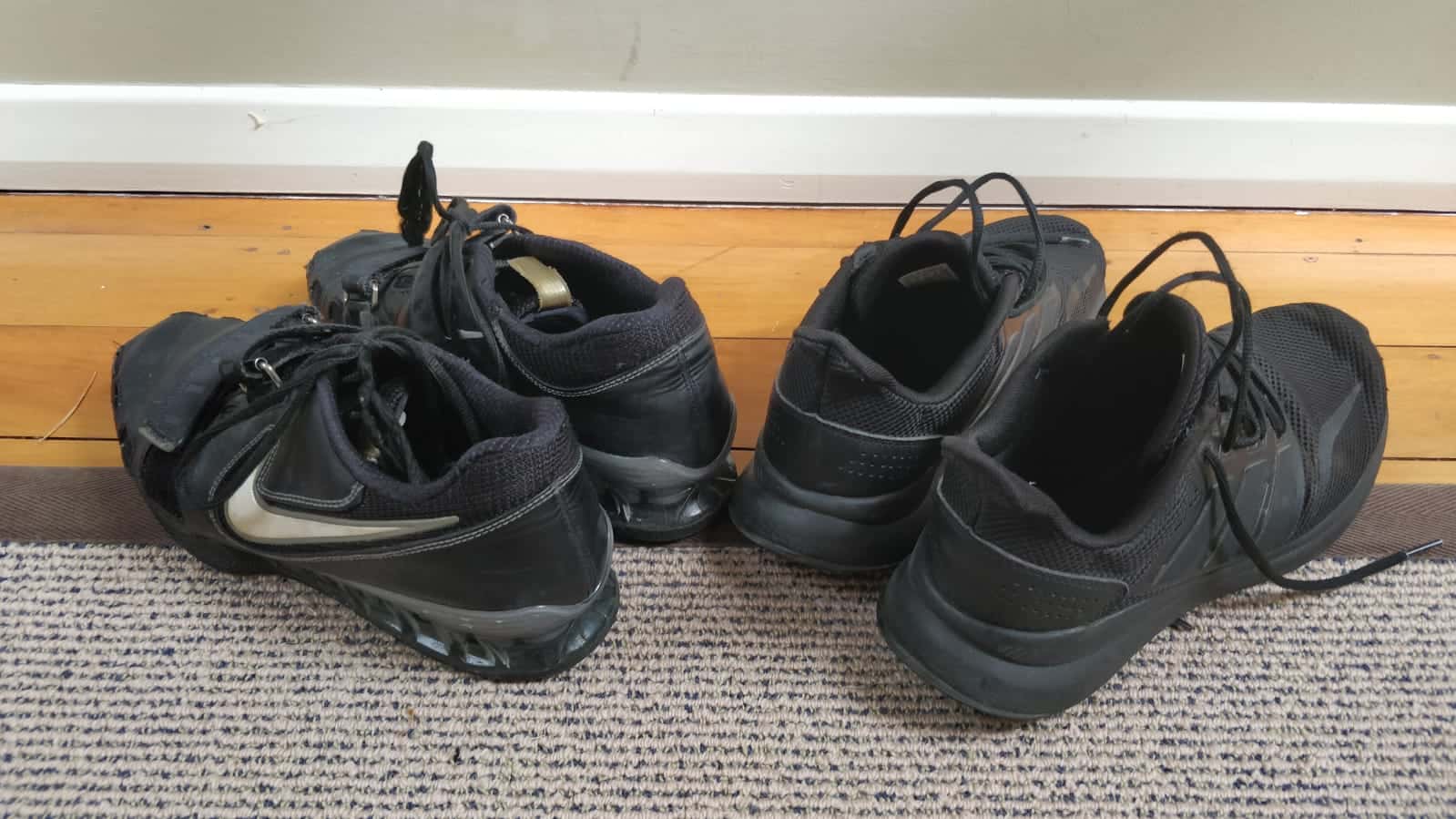
Let’s break down the benefits of using Weightlifting shoes for the sport of Olympic Weightlifting.
Raised Heel
The elevated heel of a Weightlifting shoe helps reduce the demand of ankle mobility so you can hit deeper positions with an upright posture.
This allows you to get into better positions whether that’s with the bar racked on your shoulders, back, or overhead. The overhead position is the most challenging due to the extra thoracic mobility that is needed to keep the bar overhead.
Even with decent thoracic mobility, if the ankles are a limiting factor, you will still have trouble leaning too far forward. Simply raising the heels can solve these problems instantly.
Even though many running shoes have an elevated heel, the soft cushioning actually compresses the heel so the shoe becomes flatter.
The elevated heel allows for greater knee flexion and a reduced demand for ankle flexion compared to running shoes as shown in a study in the Journal of Sports Sciences which means a deeper bottom position and greater stress on the quadriceps. Both highly important pieces to the sport of Weightlifting.
Less Lower Back Stress
An interesting study in the Journal of Sports Sciences found in novice trainees had significantly greater forces through the lumbar spine when squatting on a flat surface compared to experienced trainees. However, this difference was not present when the heels were elevated in both groups.
This would suggest that for those who are new to Weightlifting should wear Weightlifting shoes to reduce the stress placed on the lower back when practicing the sport.
Further, an elevated heel is able to reduce your forward lean when squatting and performing the lifts, which will also place less stress on your lower back. This has been shown in a study in the Journal of Strength And Conditioning Research where less trunk lean occurred compared to squatting in running shoes.
Solid Sole
The solid base of a Weightlifting shoe allows force to be directed straight down the floor without any “leaks.” Soft rubber soles can leak force in other directions due to their unstable nature.
It has been shown in Footwear Science that Weightlifting shoes allow you to push through a greater surface of your foot than running shoes. Further, running shoes tend to push a lifters center of pressure in their feet further forward towards the ball of the foot whereas Weightlifting shoes allow a lifter to push through the center of the foot when setting up.
This creates a solid base to push and allows a backward movement the center of pressure of the foot during the first pull [5]. Being too far forward regarding center of pressure of the foot makes it more difficult to shift the center of pressure back.
Foot Security
Have you ever tried performing a split jerk in normal running shoes? The soft fabric can make it feel like your foot is going to burst through the shoe and the soft rubber sole doesn’t scream stability.
A Weightlifting shoe is made of strong material that covers your foot to limit the movement of your feet when performing the lifts. Having your feet feel secure will leave you to focus on your lifting without worrying if your feet are safe.
How Should Olympic Weightlifting Shoes Fit?
Weightlifting shoes should fit similar to your normal athletic shoes. They shouldn’t be too tight or too loose.
When they are too tight, you will feel your toes being scrunched together and often an unwanted pressure on the sides of your feet which can start to feel like the onset of cramp.
You may also feel your toes jamming into the front of your shoe which can lead to toenail problems.
The feeling of Weightlifting shoes being too loose is when your heel easily slips out without much effort. You will also feel your feet move and slip around while inside the shoe. These are telling signs your shoe is too big.
Rather, they should hold your feet snugly and securely not allowing for any unwanted movement but also not causing you any pain.
When To Replace Your Weightlifting Shoes
The old saying goes, “buy nice, don’t buy twice.” This statement couldn’t ring truer for Weightlifting shoes.
A good quality pair of Weightlifting shoes can last you a lifetime. You can find them in our best Olympic Weightlifting shoes article.
We know of elite level Weightlifters who have been wearing their same shoes their whole career.
I’ve had my own Weightlifting shoes for 10 years and they are still in great shape.
But if you’ve previously bought a cheaper pair of shoes, here are some telling signs you may need a new pair.
- Cracks in the heel and base.
- Base separating from the shoe.
- Holes appearing around the toe box.
- Wearing down of one side of the heel.
Do Weightlifting Shoes Stretch?
Weightlifting shoes do stretch. When I first bought my Weightlifting shoes, I thought they were too small even though they were my normal shoe size. However, after a few uses, they stretched to my foot and I’ve been wearing them comfortably ever since.
Are Weightlifting Shoes Worth It?
Weightlifting shoes are worth getting purely for the fact they have an elevated heel which can reduce stress on your lower back and provide a solid, secure base to push from when practicing Olympic Weightlifting.