

Article written By Jay Stadtfeld
You’re in the squat rack. 500 pounds on the bar, constructed of five 45 pound plates per side, and that silly 2.5 plate. You walk over to tighten your belt to that second to last notch, throw chalk on your hands, and get your training partner to chalk your back.
You know you’re going to nail it as you walk up and place your hands on the cold knurling of the iron. You get under the bar and pop it out, except you forget one crucial part as you descend. You forgot to take a big belly of air and you fail the lift as the bar crashes into the safeties.
If you’re not angry reading that, you’re doing it wrong. I mean, really. Do you even lift? The Valsalva maneuver (what constitutes a maneuver above an action, anyway?) is something you may do without having ever thought about it.
Bending down to lift a stone and inhaling so as to protect your spine is just a normal movement, or so one would think. Though, quite often you’ll see people breathing improperly during exercise. This article is here to put the kabosh on that.
What Is The Valsalva Maneuver
The Valsalva maneuver is defined as, “a moderately forceful attempted exhalation against a closed airway…” and, in action, it’s literally that. You’re essentially packing air into the gut and forcing it against a closed glottis.
Before you start pondering, “What the hell’s a glottis?” it’s best to understand when the maneuver is performed. It should always be before the descent of the bar in both the squat and bench press, but before the ascent of the bar before the deadlift and press.
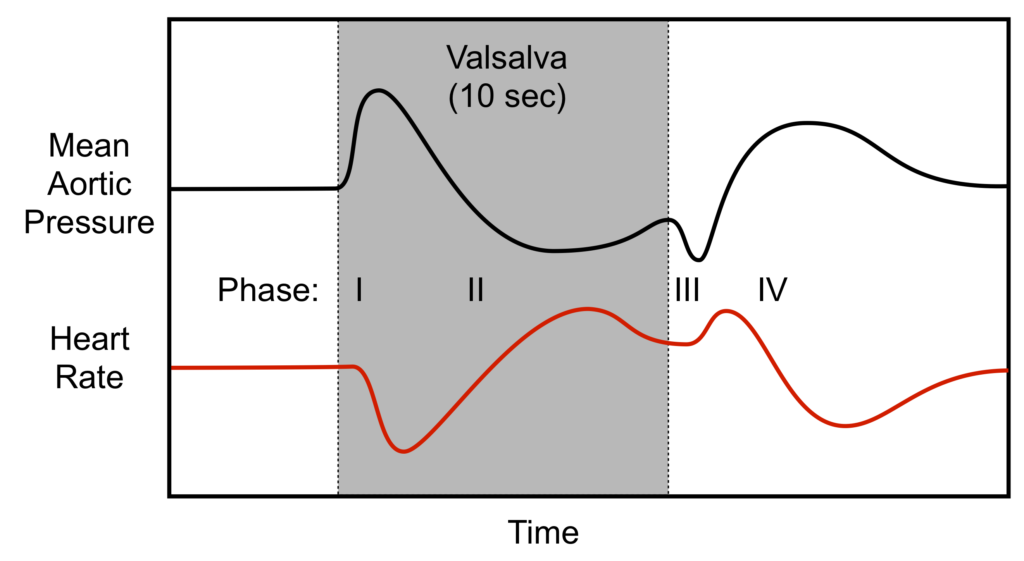
According to this graph at cvphysiology.com, you can see that during phase I of the Valsalva maneuver, the Aortic pressure takes a large spike, while the heart rate will plummet. This is largely due to the increase of air which forces the organs into the rib cage, and conversely increases pressure on the walls of the heart and compresses the vessels.
Phase II does the inverse of that, with a decrease in Aortic pressure, and an increase in heart rate. This is typically where the descent/ascent of the lift would begin. The cardiac output begins to fall, causing the Aortic pressure to fall with it.
As the lift is at the end (phase III and IV), Aortic pressure hits its lowest point, while the heart rate begins to peak again as the air is released and circulated back through the body, which then causes it to spike again as pressure is allowed back into the atrium of the heart.
Too long? Too technical? Need a Cliffnote? Your body is intelligent and knows what to do when you fill your gut with air and push it out into a belt.
The increase in intra-abdominal pressure prevents your body from folding like a lawn chair, allowing you to move heavy weights more efficiently. If you’re not using a belt while training, I suggest you get one.
If you are using one, make sure you’re using it to its full potential. Breathe deep, push your belly out (lifting heavy shit isn’t pretty, don’t make it so), and keep that air in until you complete the lift. Or else suffer my wrath. Yeah, I’ll come to where you are and punch you in the gut just to make sure you’re doing it right. Or maybe I won’t. I dunno, but why take that chance?